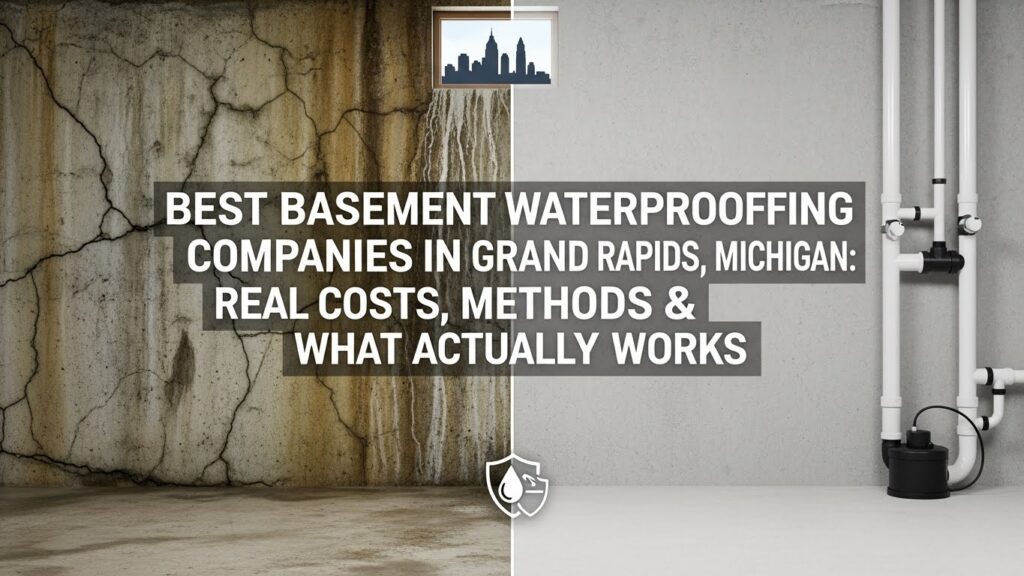
If you’re watching water seep through your basement walls after a heavy rainstorm, or you’ve walked downstairs to find standing water pooling around your foundation, you already know how stressful basement moisture problems can be. In Grand Rapids, where spring thaws and intense summer storms can dump several inches of rain in a matter of hours, basement flooding isn’t just a minor inconvenience—it’s a real threat to your home’s structural integrity and your family’s health.
Grand Rapids sits in an area with clay-heavy soil and a high water table, especially in neighborhoods closer to the Grand River. Many homes here were built in the 1950s through 1980s, when basement waterproofing standards weren’t what they are today. If your home has an older foundation, chances are the original waterproofing has long since failed, leaving your basement vulnerable every time we get significant rainfall.
This guide exists to help you identify which basement waterproofing companies in Grand Rapids can actually deliver permanent solutions—not just temporary patch jobs that fail within a year or two. We’ve evaluated local contractors based on the waterproofing methods they use, their warranty coverage, their experience with the specific soil and water conditions here in Kent County, and their track record of solving problems rather than just treating symptoms.
The companies listed here have been assessed on factors that matter: whether they address drainage issues at the source, how they handle both interior and exterior water intrusion, the quality of their sump pump systems, and whether their warranties will actually protect you if something goes wrong. This isn’t a paid directory or a list of whoever has the biggest advertising budget—it’s a practical comparison designed to help you make an informed choice when your basement is at risk.
Who This Guide Is For
This guide is for homeowners who:
- Have water actively coming through foundation walls, floor cracks, or the cove joint where walls meet the floor
- Notice dampness, musty odors, or early signs of mold growth in their basement
- Experience repeated flooding during spring thaw or after heavy rainfall
- Want a permanent waterproofing solution backed by a transferable warranty, not a quick cosmetic fix
- Are comparing multiple contractors and need clarity on what actually works versus what sounds good in a sales pitch
- Live in Grand Rapids neighborhoods particularly prone to basement moisture—areas like East Grand Rapids, Eastown, Heritage Hill, Wyoming, or Kentwood where older homes and high water tables create perfect conditions for water intrusion
This guide is NOT for:
- Homeowners looking for DIY sealant solutions or products they can apply themselves
- Minor cosmetic repairs like filling a single hairline crack that doesn’t leak
- Temporary fixes with no professional assessment of what’s causing the water problem
- Someone who just wants the cheapest quote without understanding why pricing varies dramatically between contractors
If you need a real solution that will still be working five, ten, or twenty years from now, this guide will help you understand what to look for.
How Basement Waterproofing Companies Were Evaluated
To create this ranking, we assessed contractors based on factors that determine whether a waterproofing system will actually protect your basement long-term or fail when you need it most.
Waterproofing methodology: Does the company install comprehensive drainage systems, or do they rely primarily on coatings and sealants? We prioritized contractors who address water at multiple points—exterior drainage, interior perimeter systems, proper sump pump installation, and vapor barriers where needed.
Interior vs exterior approach: The best companies evaluate each situation individually. Exterior waterproofing (excavating around the foundation and applying membrane) works well for new construction or when exterior access is easy, but it’s expensive and invasive. Interior systems (perimeter drains, sump pumps, wall vapor barriers) are often more practical for existing homes and can be equally effective when properly installed. We looked for contractors who recommend the right method for the specific problem, not just the one they prefer to sell.
Drainage system quality: A waterproofing system is only as good as where it sends the water. We evaluated whether companies install proper perimeter drainage, use reliable sump pumps with battery backup, ensure positive grading away from the foundation, and address issues like clogged gutters and downspouts that contribute to basement flooding.
Warranty coverage and length: Many companies advertise “lifetime warranties,” but the details matter enormously. We examined what’s actually covered, whether the warranty is transferable to future homeowners, whether there are maintenance requirements that void coverage, and how long the company has been in business (a 25-year warranty from a company that’s been around for three years isn’t worth much).
Inspection and diagnostic process: Before any work begins, a thorough inspection should identify why water is entering your basement. We looked for companies that take time to assess grading, downspout drainage, foundation cracks, hydrostatic pressure points, and existing sump systems rather than immediately pushing a one-size-fits-all solution.
Local experience in Grand Rapids: Contractors familiar with Kent County soil conditions, local building codes, and the specific challenges of Grand Rapids housing stock (particularly older homes with stone or block foundations) are better equipped to design systems that work in our climate. We prioritized companies with established local operations over national franchises with limited regional experience.
Pricing transparency: While no contractor will give you a final price without seeing your basement, we evaluated whether companies provide clear explanations of what drives costs and what you’re actually paying for, versus vague estimates or high-pressure sales tactics.
These criteria create a framework for identifying contractors who will solve your basement water problem permanently, not just take your money and leave you with the same issue next spring.
Quick Comparison Table
| Company | Waterproofing Method | Warranty Length | Typical Price Range | Best For | Response Time |
| Everdry Waterproofing (West Michigan) | Interior drainage systems, sump pumps, wall vapor barriers | Transferable lifetime | $3,500–$12,000+ | Comprehensive interior solutions, older homes | 1-3 days for inspection |
| Basement Systems of West Michigan | Interior WaterGuard systems, TripleSafe sump pumps | Transferable lifetime | $4,000–$15,000+ | Perimeter drainage, crawl space encapsulation | 2-5 days for inspection |
| WCI Basement Repair | Interior and exterior options, foundation repair | 25-year transferable | $3,000–$10,000+ | Combined waterproofing and foundation issues | 3-7 days for inspection |
| Ohio Basement Systems | Interior perimeter systems, dehumidification | Lifetime transferable | $4,500–$14,000+ | Comprehensive moisture control | 3-5 days for inspection |
| Local independent contractors | Varies—sump pumps, drainage, exterior membrane | 5-10 years typical | $2,000–$8,000+ | Budget-conscious repairs, straightforward problems | Varies widely |
Detailed Breakdown of the Best Basement Waterproofing Companies in Grand Rapids
1. Everdry Waterproofing of West Michigan
Everdry has operated in Michigan for decades and maintains a dedicated West Michigan division that serves the Grand Rapids area extensively. They focus primarily on interior waterproofing solutions, which makes sense for most Grand Rapids homes where excavating around the entire foundation would be cost-prohibitive or physically impractical.
Types of basement problems they handle: Recurring seepage through foundation walls, water entering through floor cracks and the cove joint, high humidity and condensation issues, and situations where exterior waterproofing isn’t feasible due to property layout or landscaping. They also work with stone and block foundations common in older Grand Rapids neighborhoods.
Waterproofing methods used: Everdry’s system typically involves installing an interior perimeter drainage channel that captures water before it enters your basement living space, directing it to a sump pump system. They install vapor barriers on walls to prevent moisture transmission and offer dehumidification systems. For situations where exterior work is possible and beneficial, they can perform excavation and apply waterproof membrane to foundation walls, though this is less common.
Warranty summary: Everdry offers a transferable lifetime warranty on their waterproofing systems, which covers both materials and labor. The warranty remains valid as long as annual maintenance is performed, which typically involves having them inspect the sump pump and drainage system. This transferability adds value if you plan to sell your home.
Pros:
- Established presence in West Michigan with long track record
- Transferable lifetime warranty provides solid protection
- Experience with older foundation types common in Grand Rapids
- Clear explanation of interior drainage methodology
- Can handle both waterproofing and minor foundation repairs in one project
Cons:
- Pricing tends toward the higher end of the market
- Annual maintenance requirement to maintain warranty coverage
- Interior-focused approach means they may not recommend exterior solutions even when beneficial
- Sales process can feel somewhat scripted
- Availability for inspections can be limited during peak spring season
Best suited for: Homeowners in established Grand Rapids neighborhoods with older homes who want a comprehensive interior solution backed by a strong warranty, particularly those dealing with consistent seepage rather than catastrophic flooding.
2. Basement Systems of West Michigan
Part of the larger Basement Systems network, this local franchise operates throughout Kent County and surrounding areas. They’ve built a reputation around the proprietary WaterGuard interior drainage system and TripleSafe sump pump products that are central to most of their installations.
Types of basement problems they handle: Water intrusion through walls and floors, crawl space moisture and encapsulation, foundation wall bowing (through their PowerBrace system), and comprehensive basement humidity control. They position themselves as full-service basement health specialists rather than just waterproofing contractors.
Waterproofing methods used: The WaterGuard system installs along the basement perimeter at the floor-wall joint, capturing water and channeling it to a sump basin. Their TripleSafe sump pump includes primary pump, secondary pump for high-volume situations, and battery backup for power outages (critical during severe storms that knock out electricity). They install CleanSpace vapor barriers on walls and offer SaniDry dehumidifiers as part of comprehensive moisture control.
Warranty summary: Basement Systems provides a transferable lifetime warranty on their waterproofing products and installation. The warranty covers system performance and includes provisions for both the drainage components and sump pump systems. Like most lifetime warranties, there are maintenance expectations.
Pros:
- Well-engineered proprietary products designed specifically for basement waterproofing
- Battery backup sump pumps standard in most systems (critical for Grand Rapids storm-related power outages)
- Can address multiple basement issues beyond just water—foundation stabilization, crawl space problems
- Strong national support network behind local franchise
- Detailed written proposals that clearly explain system components
Cons:
- Proprietary products mean you’re locked into their system for repairs or additions
- Premium pricing compared to generic drainage solutions
- Sales presentations can be lengthy and high-pressure
- Some homeowners report difficulty reaching service department during peak seasons
- Franchise model means quality can vary depending on local management
Best suited for: Homeowners who want an engineered, branded solution with comprehensive coverage including battery backup pumps, or those dealing with multiple basement issues (water, humidity, and foundation concerns) who prefer one contractor for everything.
3. WCI Basement Repair
WCI operates across Michigan and has established solid footing in the Grand Rapids market. Unlike contractors who focus exclusively on either interior or exterior methods, WCI evaluates each situation and recommends whichever approach—or combination—will work best long-term.
Types of basement problems they handle: Foundation wall cracks with active leaking, perimeter water intrusion, exterior drainage problems, foundation settlement issues combined with water infiltration, and situations requiring both interior and exterior work. They also perform foundation stabilization work when waterproofing reveals structural concerns.
Waterproofing methods used: WCI installs interior perimeter drains similar to other contractors, but they’re more willing to recommend exterior waterproofing when site conditions favor it. For exterior work, they excavate to footer level, repair foundation cracks, apply waterproof membrane, and install exterior drainage. They also address grading issues, window wells, and downspout drainage that contribute to basement flooding.
Warranty summary: WCI provides a 25-year transferable warranty on waterproofing installations, covering both materials and workmanship. While not “lifetime,” the 25-year term is long enough to matter and comes from a company that’s been operating long enough to honor it.
Pros:
- Balanced approach that considers interior, exterior, or combination solutions
- Experience with both waterproofing and foundation repair useful for older Grand Rapids homes
- More flexible on methodology than single-system contractors
- Warranty is long enough to be meaningful without the “lifetime” marketing ambiguity
- Often recommended by local realtors for pre-sale waterproofing
Cons:
- Not as specialized in interior-only solutions as contractors who focus exclusively on that approach
- Exterior excavation projects can be disruptive and weather-dependent
- Less emphasis on humidity control and dehumidification than full-service basement companies
- Service area sometimes stretches thin during busy season
- Written proposals can lack detail compared to franchise operations
Best suited for: Homeowners whose water problems involve exterior drainage issues or foundation damage, those who want a contractor willing to recommend exterior work when appropriate, or situations where foundation and waterproofing issues need to be addressed together.
4. Ohio Basement Systems
Despite the name, Ohio Basement Systems serves West Michigan including Grand Rapids through their regional offices. They’re another Basement Systems network affiliate, which means they use similar products and methodology to Basement Systems of West Michigan but operate as a separate franchise with different management.
Types of basement problems they handle: Interior water intrusion, high basement humidity, crawl space moisture and flooding, basement finishing in conjunction with waterproofing, and comprehensive moisture management including mold prevention.
Waterproofing methods used: Like other Basement Systems franchises, they install WaterGuard interior drainage along the perimeter, TripleSafe sump pump systems with battery backup, CleanSpace wall vapor barriers, and SaniDry dehumidification systems. The products are consistent across the network.
Warranty summary: Lifetime transferable warranty on waterproofing systems and products, similar to other Basement Systems affiliates. Coverage includes installation and system performance with standard maintenance expectations.
Pros:
- Same proven products as Basement Systems of West Michigan, sometimes with more availability
- Strong focus on creating dry, healthy basement environments beyond just stopping leaks
- Can coordinate waterproofing with basement finishing projects
- Detailed inspection process identifies all moisture sources
- Good communication through project completion
Cons:
- Franchise overlap in Grand Rapids area can create confusion about which Basement Systems company you’re dealing with
- Premium pricing comparable to other Basement Systems affiliates
- Proprietary systems limit future flexibility
- Some customers report longer wait times for service calls
- Sales approach emphasizes comprehensive systems that may include components beyond core waterproofing needs
Best suited for: Homeowners who want the Basement Systems product line but haven’t connected well with the local West Michigan franchise, those planning to finish their basement after waterproofing, or situations where comprehensive humidity control is as important as stopping active leaks.
5. Local Independent Contractors
Grand Rapids has several smaller, independent waterproofing contractors and general foundation repair companies that take on basement water problems. These range from one-person operations to small teams, and they typically focus on more straightforward installations without the branded systems and elaborate warranties of larger companies.
Types of basement problems they handle: Sump pump installation and replacement, basic interior perimeter drains using standard corrugated pipe and gravel, minor foundation crack repair, exterior regrading, and simpler water intrusion problems that don’t require comprehensive systems.
Waterproofing methods used: Methods vary significantly by contractor but typically involve conventional drainage solutions—perforated pipe in gravel along the foundation footer, standard sump basins and pumps, basic vapor barriers, and straightforward approaches without proprietary products. Some independent contractors have decades of experience and do excellent work; others are general contractors who occasionally take on waterproofing jobs.
Warranty summary: Usually 5-10 years on parts and labor, sometimes less. Warranties are only as good as the contractor’s longevity, and smaller operations sometimes go out of business or retire before warranty terms expire. Transferability varies.
Pros:
- Often significantly less expensive than franchise operations
- More flexible on scope—willing to tackle just the specific problem rather than selling comprehensive systems
- Local reputation matters more, so established independents prioritize quality
- Less pressure to buy add-ons or premium features
- Can sometimes schedule work faster than large companies during peak season
Cons:
- Quality varies enormously—from excellent to inadequate
- Shorter warranties that may not transfer and may not be honored if business closes
- Less sophisticated drainage products and sump systems
- Limited recourse if work fails or contractor doesn’t stand behind installation
- May not carry adequate insurance or proper licensing
Best suited for: Budget-conscious homeowners with straightforward water problems, those who’ve received personal recommendations for specific independent contractors, or situations where you need a simple sump pump installation rather than a complete perimeter system.
Our Recommended Basement Waterproofing Partner in Grand Rapids
For most Grand Rapids homeowners dealing with basement water intrusion, we recommend starting with Everdry Waterproofing of West Michigan for your initial inspection and assessment.
This recommendation comes from their established track record in Michigan, their experience specifically with the older foundation types and soil conditions common throughout Kent County, and their balanced approach that focuses on solving the problem rather than maximizing the sale. Their interior drainage systems work well for the majority of Grand Rapids basement situations, particularly in neighborhoods where homes were built before modern waterproofing standards existed.
Everdry is particularly well-suited for homes in East Grand Rapids, Heritage Hill, Eastown, and other established neighborhoods where foundation walls are stone, block, or older concrete, and where excavating around the entire foundation would be prohibitively expensive or impractical due to landscaping, driveways, and property layout. Their vapor barrier systems address the moisture transmission issues common in these older foundations.
When you contact Everdry for an inspection, they’ll send a technician to assess your specific situation—looking at where water is entering, what’s causing the intrusion, existing drainage conditions, grading issues, and the condition of your foundation. They should provide a written proposal that explains what system they’re recommending and why, breaking down the components and how they work together. This inspection is typically free with no obligation.
What makes Everdry a solid recommendation for most situations is their transferable lifetime warranty, which adds real value if you’re planning to sell your home in the future. Potential buyers take basement waterproofing seriously in Grand Rapids, and a transferable warranty provides credibility that the work was done properly. Just understand that maintaining warranty coverage requires periodic inspections.
That said, Everdry isn’t necessarily the right fit for everyone. If your situation requires significant exterior work, foundation repair beyond minor crack sealing, or if you’re on a tight budget, you may want to get competing bids from WCI Basement Repair or a reputable local independent contractor. But for the majority of basement water problems in Grand Rapids homes, Everdry’s approach delivers reliable, long-term results.
Basement Waterproofing Cost in Grand Rapids
Understanding what basement waterproofing actually costs in Grand Rapids helps you evaluate whether quotes you’re receiving are reasonable or whether a contractor is either lowballing to get the work or overcharging because they think you’re desperate.
Interior perimeter drainage systems typically run $3,500 to $8,000 for an average basement (roughly 1,000-1,500 square feet). This includes installing drain tile along the perimeter, a sump basin and pump, and basic wall vapor barriers. More complex installations with multiple sump pumps, battery backup systems, or dehumidifiers can push costs to $10,000-$15,000.
Exterior excavation waterproofing costs significantly more—usually $8,000 to $20,000 or higher—because it involves excavating around the foundation perimeter (or the problem section), repairing foundation walls, applying waterproof membrane, installing exterior drainage, and restoring landscaping. This makes sense for new construction or severe foundation problems, but it’s often overkill for typical basement seepage.
Sump pump installation by itself ranges from $800 to $2,500 depending on basin size, pump quality, whether you’re adding battery backup, and how much drainage work is involved. High-end systems with dual pumps and sophisticated battery backup run $3,000-$4,500.
Crawl space encapsulation (if your home has a crawl space rather than full basement) typically costs $3,000 to $8,000 depending on size, existing moisture problems, and whether you’re adding dehumidification and drainage improvements.
Mold remediation is usually a separate service that runs $1,500 to $5,000+ depending on how extensive the growth is. Many waterproofing contractors will remove minor mold as part of their prep work, but serious infestations require specialized remediation before waterproofing begins.
What drives costs higher:
The size of your basement makes an obvious difference—a 2,000 square foot basement costs more to waterproof than a 1,000 square foot space. Foundation type matters too; older stone or block foundations require more careful work than poured concrete. If your basement has finished walls that need to be removed to access the foundation, that adds demolition and disposal costs. High water table situations or problematic soil conditions may require more robust drainage systems. And if your home lacks proper exterior grading or has downspouts that dump water right next to the foundation, addressing those issues adds cost but is often necessary for the waterproofing to work long-term.
What “cheap quotes” often miss:
When one contractor’s bid comes in at $2,000 while everyone else is quoting $6,000-$8,000, the low bidder is usually cutting corners somewhere. Common shortcuts include inadequate drainage that won’t handle heavy water volume, standard sump pumps without battery backup (useless during storms that knock out power), no vapor barriers on walls (so you still get dampness and humidity even though water isn’t pooling on the floor), minimal warranty coverage, or simply planning to do the bare minimum and collect payment regardless of whether it actually solves your problem.
The temptation to accept the lowest bid is understandable, especially when you’re already stressed about water in your basement. But waterproofing is one of those situations where paying for proper installation the first time costs less than paying twice—once for the cheap system that fails, then again for the contractor who actually fixes it correctly.
Interior vs Exterior Waterproofing (What Actually Works Long-Term)
One of the first decisions in basement waterproofing is whether to work from the inside, the outside, or both. Understanding the real differences—not just what salespeople tell you—helps you evaluate whether a contractor’s recommendation makes sense for your situation.
Exterior waterproofing involves excavating around your foundation down to the footer level, repairing any cracks or damage in the foundation wall, applying a waterproof membrane or coating to the exterior surface, and installing drainage tile at the footer to carry water away. In theory, this is the most comprehensive approach because it stops water before it ever reaches the foundation.
The reality is that exterior waterproofing is extremely disruptive—excavation means tearing up landscaping, sidewalks, decks, or porches that are built close to the house. It’s weather-dependent (can’t excavate in freezing conditions), expensive, and often impractical in Grand Rapids neighborhoods where homes are close together or where property line setbacks don’t allow heavy equipment access. It makes sense for new construction, for homes with severe foundation damage that requires exterior repair anyway, or when you’re already doing major landscaping work. For most existing homes dealing with typical basement seepage, the cost and disruption outweigh the benefits.
Interior waterproofing manages water after it reaches the foundation but before it enters your living space. A perimeter drainage system installed along the basement floor captures water that comes through the foundation, channeling it to a sump pump that discharges it away from the house. Vapor barriers on the walls prevent moisture transmission that causes dampness and musty odors even when you’re not getting actual puddles.
The advantage of interior systems is that they work regardless of what’s happening outside your house—poor grading, hard rain, high water table, whatever. They’re less expensive, less disruptive, can be installed year-round, and when properly designed, they’re just as effective as exterior waterproofing for the majority of basement water problems. The drain system intercepts water at the most vulnerable point (the cove joint where floor meets wall), and modern sump pumps are reliable enough that the water gets removed before it causes problems.
Why some contractors push one method over the other:
Companies that specialize in exterior waterproofing often claim it’s the “only real solution” because it sounds more comprehensive and justifies higher pricing. Interior-focused contractors sometimes dismiss exterior work as unnecessarily expensive. The honest answer is that both approaches work when properly installed, and the right choice depends on your specific situation.
Exterior waterproofing makes more sense when:
- You have significant foundation wall damage that requires exterior repair
- You’re dealing with severe hydrostatic pressure from a high water table
- Your property layout makes excavation practical and affordable
- You’re already doing major exterior work and can add waterproofing to the project
Interior waterproofing makes more sense when:
- You have typical basement seepage through walls or the floor-wall joint
- Excavation would be impractical due to property layout, landscaping, or structures built close to the foundation
- Cost is a significant consideration
- You want minimal disruption and faster completion
In many Grand Rapids homes, the most practical approach combines elements: interior perimeter drainage system for water management, plus addressing exterior issues like poor grading, clogged gutters, or downspouts that dump water against the foundation. This combination costs less than full exterior excavation while solving the root causes of basement water intrusion.
Common failure points to watch for:
Interior systems fail when drainage capacity is inadequate for water volume, when sump pumps fail during power outages (why battery backup matters), or when the system isn’t properly connected to capture water all along the perimeter. Exterior systems fail when waterproof membranes develop leaks (and you won’t know until water is in your basement again), when exterior drainage gets clogged with roots or sediment, or when the excavation wasn’t taken deep enough to address the actual water source.
The key is matching the solution to the problem. A good contractor evaluates your specific situation and recommends what will actually work, not just what they happen to specialize in or what earns them the highest profit margin.
Common Basement Waterproofing Mistakes Homeowners Make
When your basement is flooding, the pressure to solve the problem immediately can lead to decisions that end up costing more money without actually fixing anything. Here are the mistakes that create the most regret:
Accepting the lowest quote without understanding why it’s lower. If one contractor bids $3,000 while three others bid $7,000-$8,000, the low bidder isn’t doing you a favor—they’re either planning to cut corners, use inferior materials, or do the minimum work required to collect payment. Basement waterproofing is not an area where bargain hunting pays off. The cost of doing it wrong and then paying someone else to fix it exceeds the cost of doing it right the first time.
Focusing on interior cosmetic fixes while ignoring exterior drainage problems. You can install the most sophisticated interior drainage system in the world, but if your gutters dump hundreds of gallons of water right next to your foundation during every rainstorm, you’re fighting a losing battle. Proper grading that slopes away from the house, downspouts that discharge at least 6-10 feet from the foundation, and functional gutters prevent huge volumes of water from ever reaching your basement. Many contractors will recommend interior work without addressing these exterior contributors because it’s easier to sell, but ignoring them means your system works harder and fails sooner.
Relying only on sealants and crack fillers. Hydraulic cement, waterproof paint, and crack injection products have their place for minor moisture issues, but they’re not solutions for active water intrusion. When water is coming through your foundation due to hydrostatic pressure, coating the interior surface just forces it to find another path. You’ll spend hundreds on sealants that fail within months while the real problem—inadequate drainage—remains unaddressed.
Not verifying warranty transferability and terms. A “lifetime warranty” sounds great until you discover it’s not transferable when you sell your home, or that it requires annual paid maintenance to stay valid, or that it only covers materials but not labor (so you’re paying $3,000 in labor costs when a $200 component fails). Before signing anything, get written clarification on exactly what’s covered, for how long, under what conditions, and whether it transfers to future owners.
Choosing a contractor based on high-pressure sales tactics rather than substance. If a salesperson is creating artificial urgency (“this price is only good if you sign today”), refusing to provide written proposals that you can review at home, or dismissing your desire to get competing bids, these are red flags. Legitimate contractors understand that waterproofing is a major investment and that homeowners need time to evaluate options.
Not addressing the root cause, only the symptoms. Water in your basement is a symptom. The root cause might be inadequate perimeter drainage, foundation cracks allowing water intrusion, poor grading, or a high water table creating hydrostatic pressure. Contractors who immediately start talking about the work without thoroughly diagnosing why you have water in your basement are solving the wrong problem. You want someone who spends time figuring out where the water is coming from and why before proposing a solution.
Delaying action until damage is severe. Every day that water sits in your basement increases the risk of mold growth, foundation deterioration, and structural damage. Waiting until you have severe foundation problems to address basement water turns a $5,000 waterproofing project into a $15,000 foundation repair and waterproofing project. Early intervention costs less and prevents compounding damage.
What To Do If Your Basement Is Leaking Right Now
If you’re currently dealing with active water intrusion—whether it’s a steady trickle through a wall crack or several inches of standing water—here’s what to do while you’re arranging for a permanent fix:
Immediate actions:
Remove anything stored on the basement floor that water could damage—particularly cardboard boxes, fabric items, and anything irreplaceable. Even if water hasn’t reached these items yet, humidity in a flooded basement causes damage quickly.
If you have significant standing water and the source isn’t actively spraying or gushing (which might indicate a plumbing failure requiring immediate emergency repair), use a wet-dry vacuum to remove as much water as you can. Many hardware stores rent commercial-capacity water extraction equipment if you’re dealing with extensive flooding.
Identify where water is entering. Is it coming through cracks in the walls? Seeping through the floor-wall joint? Rising through floor cracks? Documenting where water appears helps contractors diagnose the problem faster.
If you don’t already have a working sump pump and you have a sump basin, now is the time to install one temporarily or call an emergency plumbing service. Most sump pump installations can be done same-day or next-day if you’re dealing with active flooding.
What NOT to do:
Don’t ignore standing water thinking it will drain on its own or that one flooding event isn’t a big deal. Even shallow standing water creates conditions for mold growth within 24-48 hours. Water that sits against foundation walls accelerates deterioration of concrete or block foundations.
Don’t attempt to repair foundation cracks yourself with hydraulic cement or waterproof coatings while water is actively flowing—these products don’t adhere properly to wet surfaces and won’t stop the leak. You’re wasting time and money on a temporary measure that will fail.
Don’t use electrical equipment in standing water without ensuring the power is off to that area. If you’re using a wet-dry vac or dehumidifier, make sure outlets and cords aren’t submerged.
Don’t pump out a fully flooded basement all at once if the water has been there for more than a day or two. Rapid removal of water pressure against foundation walls while soil outside is still saturated can cause wall collapse in extreme cases. Remove water gradually, about a third at a time over several hours. This is more relevant for severe flooding (several feet of water), not minor seepage.
When to call a professional:
Call immediately if water is entering so fast that it’s overwhelming your ability to remove it, if you see structural cracks that are opening or getting worse, if the water is contaminated with sewage, or if you’re dealing with several inches of standing water that keeps returning despite your removal efforts.
For less catastrophic but persistent water problems—steady seepage, recurring dampness after storms, musty odors suggesting hidden moisture—schedule an inspection within a few days. The urgency is less immediate, but you don’t want to wait weeks or months. Water problems don’t improve on their own, and the longer you wait, the more secondary damage occurs.
How quickly damage escalates:
Mold begins growing within 24-48 hours in damp conditions. What starts as water on the floor becomes a mold problem within a few days if not addressed. Efflorescence (white chalky deposits on foundation walls) indicates water is moving through the concrete, bringing minerals with it—this weakens the concrete over time. Wood framing, insulation, drywall, and carpet stored in basements deteriorate rapidly when exposed to moisture. Foundation walls subjected to repeated wetting and drying cycles develop cracks and spalling (surface flaking) that worsen over time.
The point isn’t to panic but to recognize that “wait and see” isn’t a viable strategy with basement water problems. Address the immediate water, then arrange for proper waterproofing before the next storm creates the same situation again.
Frequently Asked Questions
How long does basement waterproofing take to complete?
Most interior perimeter drainage installations take 2-4 days depending on basement size and complexity. The work involves breaking up a section of concrete floor along the perimeter, installing drainage tile and sump basin, connecting everything properly, and pouring new concrete. You’ll need to stay out of the basement during the work, and the concrete needs 24-48 hours to cure before you can walk on it normally. Exterior waterproofing takes longer—usually 5-10 days—because of excavation, foundation work, backfilling, and landscape restoration. Weather delays are common with exterior projects.
Will waterproofing stop mold growth in my basement?
Waterproofing addresses the moisture source that allows mold to grow, but it doesn’t remove existing mold. If you have visible mold growth (black, green, or white patches on walls, floor joists, or stored items), that needs to be removed through proper remediation either before or immediately after waterproofing. Most waterproofing contractors will handle minor mold cleanup as part of their prep work, but extensive growth requires specialized mold remediation services. Once your basement is properly waterproofed and you maintain low humidity (ideally below 60%), mold can’t establish new growth.
Are permits required for basement waterproofing in Grand Rapids?
Requirements vary depending on scope of work. Interior perimeter drainage systems typically don’t require permits because they’re considered maintenance rather than structural modification. Exterior excavation waterproofing sometimes requires permits depending on how close you are to property lines, whether you’re affecting drainage easements, and local ordinances. Foundation repairs involving structural components usually need permits and inspections. Reputable contractors know local permit requirements and handle the filing for you—if a contractor dismisses permit questions or suggests avoiding the permit process to save money, that’s a warning sign. Working without required permits can create problems when you try to sell your home.
Does homeowners insurance cover basement flooding or water damage?
Standard homeowners insurance policies typically do NOT cover water damage from groundwater seepage, flooding, or sump pump failure. They cover sudden, accidental water damage from burst pipes or plumbing failures, but not the slow or recurring water intrusion that basement waterproofing addresses. If you want coverage for flooding, you need a separate flood insurance policy through FEMA’s National Flood Insurance Program, though even this has limitations on basement coverage. Some insurers offer sump pump backup riders or water backup coverage as add-ons to standard policies. Before assuming insurance will cover your basement water damage, review your policy carefully or call your agent. Most waterproofing is an out-of-pocket investment.
Do waterproofing warranties transfer to new homeowners?
This depends entirely on the contractor and the specific warranty. Many reputable companies offer transferable warranties—meaning if you sell your home, the new owner receives the remaining warranty coverage. This adds significant value when selling because buyers in Grand Rapids know basement water is a concern and appreciate homes with warranted waterproofing systems. Always get written confirmation that the warranty is transferable and understand any requirements (like registered transfer notifications or maintenance records). Non-transferable warranties protect only you, which matters less if you’re planning to move within a few years.
What’s the difference between a sump pump and a sewage pump?
A sump pump removes clean groundwater that collects in your sump basin, discharging it outside away from your foundation. A sewage pump (or sewage ejector pump) handles wastewater from basement bathrooms, laundry, or other plumbing fixtures, pumping it up to the main sewer line. They’re different systems designed for different purposes. Sump pumps aren’t built to handle sewage, and sewage pumps aren’t designed for the continuous-duty requirements of groundwater removal. If your basement has both groundwater issues and below-grade plumbing fixtures, you need both types of pumps.
How do I maintain a basement waterproofing system?
Interior perimeter drainage systems need minimal maintenance—primarily keeping the sump pump functioning properly. Test your sump pump every few months by pouring water into the basin until it activates. Replace the pump every 7-10 years even if it seems to be working (they don’t fail gradually; they just stop). If your system has battery backup, test it regularly and replace batteries according to manufacturer recommendations. Keep the area around the sump basin clear so you can access it for inspection. Have your system inspected annually if that’s a warranty requirement. For exterior systems, keep gutters clean, ensure downspout extensions remain in place, and maintain proper grading away from your foundation.
Can I finish my basement after waterproofing?
Yes, and many homeowners waterproof specifically because they want to finish their basement but need to address moisture first. Wait at least a full season after waterproofing installation to ensure the system works properly before investing in finishing. When you do finish, use water-resistant materials—avoid standard drywall directly against foundation walls, use rigid foam insulation rather than fiberglass batts, consider luxury vinyl flooring rather than carpet. Even with perfect waterproofing, basements are higher-humidity environments than upper floors. Contractors experienced with basement finishing in Grand Rapids understand which materials work reliably in below-grade spaces.
Final Verdict & Next Steps
Basement waterproofing in Grand Rapids isn’t optional—it’s essential maintenance for protecting one of your largest investments. Between our clay soil, seasonal water table fluctuations, and the age of housing stock throughout Kent County, basement moisture problems are common enough that ignoring them inevitably leads to worse damage and higher costs down the road.
The companies ranked in this guide all have the capability to solve typical basement water problems effectively. Your choice depends on your specific situation: whether you need comprehensive interior drainage, whether foundation issues need to be addressed simultaneously, whether budget is the primary constraint, and what level of warranty protection matters for your plans with the home.
For most Grand Rapids homeowners, starting with Everdry Waterproofing’s inspection provides a solid baseline assessment from a contractor with established local experience. Getting competing quotes from WCI or one of the Basement Systems affiliates gives you comparison points on both approach and pricing. If your situation is straightforward and budget-conscious, a reputable independent contractor might deliver equal results at lower cost—but verify their credentials, insurance, and warranty carefully.
The homeowners who regret their waterproofing decisions are almost always those who either delayed too long and dealt with extensive secondary damage, or those who chose the cheapest option without understanding the shortcuts being taken. The homeowners who are satisfied are those who invested in proper solutions early, worked with contractors who diagnosed the real problem rather than just selling product, and received systems backed by meaningful warranties.
If your basement is currently dry, maintaining it that way costs far less than fixing water damage after it starts. If you’re already dealing with moisture or flooding, addressing it now prevents compounding problems with mold, foundation deterioration, and structural damage.
The next step is straightforward: contact 2-3 contractors from this list, schedule inspections, and get written proposals that explain what they’re recommending and why. Ask questions about warranty terms, what’s included in pricing, their experience with situations similar to yours, and how they’ll address both the symptoms and root causes of your basement water issues. Take time to evaluate your options, but don’t let weeks turn into months while water continues damaging your foundation.
Grand Rapids basements can absolutely be kept dry long-term—you just need the right system, properly installed, by contractors who understand the specific conditions we deal with here in West Michigan.